
Abstract
This RPIP serves as a guide to understanding the governance processes of the Rocket Pool protocol. It provides an overview of the powers and authorities held by various governance actors, including the oDAO, pDAO, established committees, and other relevant roles.
Motivation
This informational document seeks to clarify the existing governance structure and delineate the powers and authorities of established entities clearly, to ensure transparency and efficiency in Rocket Pool’s decision-making process. We believe doing so will also positively affect:
- Ease of onboarding new contributors to Rocket Pool Governance.
- General knowledge about the protocol and how it operates.
- Ability to identify stakeholders and their responsibilities.
In short, having better baseline information improves the quality of contributor life for the protocol, and establishing this work as an informational RPIP would make it easier to access and trust the validity of the described areas.
Specification
Definitions
There are several terms used in this document that are worth defining explicitly to avoid misunderstanding and ambiguity.
Principal
An individual or entity that can be said to ‘own’ the protocol.
Agent
An individual or entity that provides some service to the principals, or holds power delegated by the principals.
Power
Power in this document is used to refer to the raw capability to do something. This refers to explicit permissions granted in the protocol’s smart contracts, administrative access to software platforms, and so on.
A principal or agent has the power to perform action X when every limitation to their role in performing action X is self-applied, rather than being applied by another party.
To give an example, the oDAO has the power to report any rETH price for protocol use. Regardless of what independent users are seeing for price action in trading pools, the oDAO has the technical permissions needed to update rETH price to whatever they see fit.
Best expressed in the phrase: ‘Are we able to do X?’
Authority
Authority in this document is used to refer to the right to do something. This refers to the implicit and explicit decisions made by the community at large as to ‘who do we want to do X’.
Authorities are a bit complex in that they often stem from a string of decision-making powers, some implicit and some explicit. This RPIP seeks to document what clear authorities exist based on approved governance actions and their ramifications, but may not be able to capture the full intricacy of who has the “right” to take an action.
A principal or agent has the authority to do X if the Rocket Pool community has explicitly or implicitly agreed that that principal or agent is allowed or supposed to be doing X.
To give an example, the pDAO has the authority to make changes to the Rocket Pool Protocol due to the shared understanding of the community that legitimate pDAO votes represent the will of the organization and should be adhered to absent outside factors.
Best expressed in the phrase: ‘Are we allowed to do X?’
Principals and Agents
oDAO governance
Description
OracleDAO governance is defined as successful on-chain governance proposals voted on by oDAO members running oDAO nodes.
Powers
- The oDAO has the power to replace any upgradeable contract (excludes RocketStorage and the token contracts) in the Rocket Pool protocol via the oDAO upgrade power, provided it is not vetoed by the Security Council and the required time delay has elapsed.
- The oDAO has the power to modify any non-protected parameter in the Rocket Pool protocol via the oDAO upgrade power, provided it is not vetoed by the Security Council and the required time delay has elapsed.
- The above has several implications, most notably the ability to set the Minipool penalty within the bounds of the maximum penalty. A pDAO-controlled guardrail caps how much can be penalised over time.
- The oDAO has the power to modify oDAO settings via the oDAO settings pathway.
- The oDAO has the power to take actions that modify the membership of the oDAO.
- The oDAO has the power to determine the split of RPL inflation on a rewards Merkle tree. [GitHub]
- The oDAO has the power to set the protocol’s rETH exchange rate [Etherscan].
- Note that manipulating this value would allow for withdrawing ETH at the wrong cost (from both the deposit pool contract and rETH token contract).
- This is limited to a max of 2% per day based on pDAO settings [Etherscan; getMaxRethDelta and getSubmitBalancesFrequency].
- The oDAO has the power to approve the canonical rewards Merkle tree at the end of each reward period. [Etherscan] This uses a separate governance pathway.
Authorities
- Once the pDAO has ratified an upgrade, oDAO is granted the authority and is obligated to replace upgradeable contracts in the Rocket Pool protocol via the oDAO upgrade power.
- oDAO has the authority to veto changes approved by the pDAO if they have reason to believe the changes meet any of the following criteria according to [RPIP-24]:
- Malicious
- Not voted by the pDAO
- A result of vote manipulation in the pDAO
- Would result in clear damage to the Rocket Pool project
- The oDAO has the authority to maintain its own membership. [RPIP-24]
Guardian
Description
The guardian address is an EOA defined in the RocketStorage contract (but outside the key-value mappings.) It was responsible for the initialization of the protocol. Almost all of its initial powers have been irrevocably disabled.
The guardian address is likely controlled by Rocket Pool Pty Ltd.
Powers
- The Guardian has the power to set the maximum penalty rate in the RocketMinipoolPenalty contract. This sets the maximum rate at which the oDAO can penalise minipools (megapool validators are excluded); it is currently set to zero.
Authorities
No authorities have been assigned to the guardian address by the pDAO. Indirect authorities are inherited from the assumption that the guardian is controlled by Rocket Pool Pty Ltd and are listed in that section.
Security Council
Description
The Security Council is an onchain body that acts as a fast-response safety mechanism. Its membership and quorum are controlled by the pDAO.
Powers
- The Security Council has the power to make immediate changes, without the standard proposal delay, to a defined subset of guardrailed pDAO parameters, provided a quorum of council members (set by the security.members.quorum parameter) vote in favour.
- The Security Council has the power to adjust the protocol’s commission-split contract within bounds defined by the pDAO, serving as a governance safety mechanism.
- The Security Council can veto protocol upgrades during a mandatory pre-launch delay period.
Authorities
- The Security Council has the authority to act as an emergency responder for the protocol, to contain incidents by utilising temporary pausing powers, subject to removal of individual members or dissolution of the council entirely by the pDAO at any time.
- Individual members have the authority to resign via a two-step, notice-and-delay exit process rather than leaving unilaterally and immediately.
pDAO governance
Description
ProtocolDAO governance is defined as successful governance proposals voted on by Rocket Pool community members running Registered Nodes using a trustless onchain fraud-proof voting system. A node’s voting power is a function of its staked RPL. Proposals require a bond, may be challenged by other node operators, and pass through a mandatory challenge period delay and two-phase voting process before execution.
Powers
- The pDAO has the power to raise and execute “Parameter Change” proposals.
- These proposals can modify a defined table of protocol parameters across many categories (deposit, inflation, minipool/megapool, network, node, rewards, proposal, auction, security-council).
- The pDAO has the power to raise and execute “Treasury Spend” proposals, which send treasury RPL to a specified address
- The pDAO has the power to raise and execute “Treasury Contract” proposals, which allow recurring treasury RPL claims by a specified address
- The pDAO has the power to raise and execute “Security Council Change” proposals
- These proposals can invite Security Council members
- These proposals can remove Security Council members
- These proposals can set the Security Council’s quorum
- The pDAO has the power to veto a proposal it deems spam or malicious via a dedicated on-chain veto vote, with a successful veto burning the proposer’s bond
Authorities
The pDAO as a collective is considered the principal of the Rocket Pool protocol. Authority over the Rocket Pool protocol lies with the pDAO, except that which relates to the oDAO, which maintains authority over itself. Changes to the protocol are only allowed to be done through following the pDAO’s governance process.
Its authorities include, but are not limited to:
- The authority to add, remove, replace, or amend RPIPs.
- The authority to determine the membership of committees defined by RPIPs.
- The authority to add, remove, or upgrade the functionality of the Rocket Pool protocol.
- The authority to determine the distribution of RPL inflation.
- The authority to engage agents on its behalf.
- The authority to delegate specific authorities to separate governance processes.
Individual Registered Nodes (oDAO or pDAO)
Description
Any individual Rocket Pool Registered Node. All pDAO members must have a Registered Node. All oDAO members must have a registered node.
Powers
- Registered Nodes have the power to challenge an individual oDAO member to ensure they are fulfilling their responsibilities. [Etherscan]
- Registered Nodes have the power to become oDAO members unilaterally if there are less than 3 oDAO members. [Etherscan]
- Registered Nodes have the power to accept an invitation to the oDAO. [Etherscan]
Authorities
There are no protocol-affecting authorities held by individual Registered Nodes.
Rocket Pool Pty Ltd
Description
Rocket Pool Pty Ltd is the legal entity that created and deployed the Rocket Pool Protocol. It still retains relevant intellectual property rights but has transferred much of its powers and authorities to the DAO structures.
Powers
- Rocket Pool Pty Ltd has the power to moderate and modify the Rocket Pool Discord Server.
- Rocket Pool Pty Ltd has the power to moderate and modify the Discourse forum instance.
- Rocket Pool Pty Ltd has the power to add and remove documentation to the official documentation page.
- Rocket Pool Pty Ltd has the power to administer the Rocket Pool Github organization.
- Rocket Pool Pty Ltd has the power to administer and author polls on the Rocket Pool Snapshot instance. This includes the ability to add or modify voting strategies.
Authorities
As founder of the protocol, Rocket Pool Pty Ltd has broad implied authority in areas where the pDAO has not claimed or revoked it.
While the full social authorities for the company are hard to capture due to the many contributions made by the organisation over the years, the following categories are noteworthy:
- Domain names
- Important domains include:
- dao.rocketpool.net (forum)
- stake.rocketpool.net (user-facing staking site)
- delegates.rocketpool.net (delegate profiles)
- Important domains include:
- Trademarks
- Sanctioning of the bug bounty program.
- RPIP-84 gives a member of Rocket Pool Pty the role of Lead Vote Administrator for the Recognized Signaling Platform for votes that are conducted offchain.
Software Pipeline
The powers and authorities above can be quite broad-reaching but may cover up some important explicit procedures of trust carried by Rocket Pool Pty Ltd.
- Rocket Pool Pty Ltd verifies updates to the Smartnode Repository and releases them with the expectation that node operators will manually update to new releases.
RPIP Editors
Description
RPIP Editors are tasked with ensuring RPIP documents are finalized and correctly formatted before voting. The position is apolitical, with RPIP Editors not making value judgments in their duties, but rather evaluating based on completeness and format. [RPIP-1]
Powers
- RPIP Editors have the power to modify RPIPs.
- RPIP Editors have the power to determine RPIP status.
Authorities
- RPIP Editors have the authority to determine when an RPIP is “sound and complete.”
- RPIP Editors have the authority to assign an RPIP number.
- RPIP Editors have the authority to require title changes to RPIPs.
- RPIP Editors have the authority to determine RPIP status.
- RPIP Editors have the authority to require updates to an RPIP’s formatting, spelling, and markdown style.
GMC
Description
The Grants Management Committee exists to distribute grants and bounties, retrospectively and prospectively, to further the goals of the Rocket Pool protocol. Bound by [RPIP-40], this committee must consist of seven members.
Powers
- The GMC has the power to use funds sent to the GMC’s multisig.
- The GMC has the power to add or remove an address from the GMC’s multisig.
Authorities
- The GMC has the authority to distribute its share of the pDAO’s budget on a rolling basis, in the form of grants, bounties, and retrospective awards.
- The GMC has the authority to remove a GMC member with a vote of ⅔ of the committee so long as it does not violate the multisig requirements agreed by the pDAO [RPIP-10].
- The GMC has the authority to select a GMC Administrator for the committee, through a majority vote of current GMC members.
- The GMC has the authority to select an interim GMC Administrator in the event of a vacancy.
- The GMC has the authority to remove the GMC Administrator through a majority vote.
GMC Administrator
Description
The Grants Management Council Administrator is responsible for overseeing and facilitating GMC operations, specifically the rolling awards process introduced by [RPIP-26]. The GMC Admin is expected to perform various tasks supporting the efficiency of the GMC such as meeting coordinator, awards facilitator, spokesperson, grants and bounties liaison, treasurer, and governance author.
Powers
- The GMC Administrator has no direct, on-chain power over the Rocket Pool protocol.
- The GMC Administrator has no power over funds sent to the GMC multisig.
Authorities
- The GMC Administrator has the authority to coordinate the voting members of the GMC.
- The GMC Administrator has the authority to interact with parties external to the GMC on its behalf.
IMC
Description
The Incentives Management Committee oversees funds and liquidity incentives for Rocket Pool. Primarily its goal is to support rETH liquidity with a secondary focus on RPL liquidity. [RPIP-20]
Powers
- The IMC has the power to use funds sent to the IMC’s multisig.
- The IMC has the power to add or remove addresses from the IMC’s multisig.
Authorities
- The IMC has the authority to distribute funds for supporting rETH liquidity up to the annual allocation determined in [RPIP-20].
- The IMC has the authority to distribute funds for supporting RPL liquidity up to 10% of the annual allocation determined in [RPIP-20].
- The IMC has the authority to remove an IMC member with a vote of ⅔ of the committee so long as it does not violate the multisig requirements agreed upon by the pDAO. [RPIP-10]
pDAO Treasurer
Description
pDAO Treasurer is a position appointed by [RPIP-10] that is responsible for reporting on pDAO expenditures.
Powers
The pDAO Treasurer has no direct, on-chain power over the Rocket Pool protocol.
Authorities
- The pDAO Treasurer has the authority to classify expenditures to the greater community.
- The pDAO Treasurer has the authority to cast the tie-breaking vote in an interim GMC Administrator election. [RPIP-26]
- The pDAO Treasurer has the authority to randomly select from tied candidates in committee member elections. [RPIP-10]
Appendix
Technical Design of Governance
On the technical side, governance of the Rocket Pool protocol is achieved via several main pathways:
- The pDAO onchain proposal pathway (parameter changes, treasury spend, Security Council changes)
- The Security Council pathway (immediate changes to a guardrailed subset of pDAO parameters)
- The oDAO settings pathway (change oDAO settings)
- The oDAO upgrade pathway (add/remove/replace contracts)
- The Guardian initialization pathway (no longer usable)
At the time of writing, the ‘owners’ of each pathway are:
- pDAO onchain proposal pathway - pDAO (Registered Nodes with non-zero voting power)
- Security Council pathway - Security Council (members appointed by the pDAO)
- oDAO settings pathway - oDAO
- oDAO upgrade pathway - oDAO
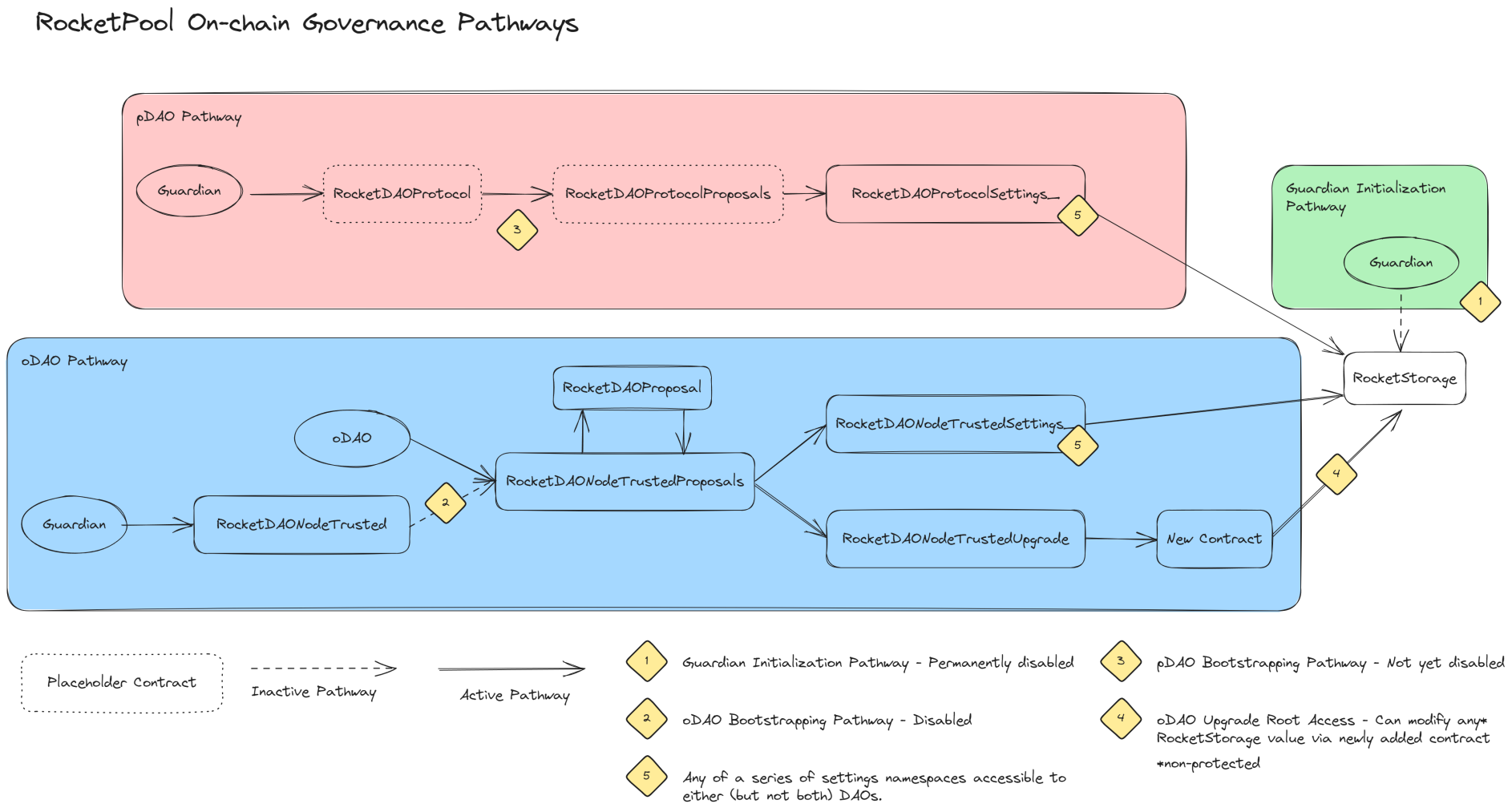
Usage of the oDAO pathways to do anything requires a majority vote from oDAO members. There is an upgrade delay of 7 days of ODAO period, plus 7 days of veto before execution.
pDAO onchain proposals are subject to a bonded propose-and-challenge period, a mandatory pre-vote delay, and a two-phase vote before execution.
Security Council actions take effect immediately once quorum is reached. It is worth emphasizing this is limited to a pre-approved, guardrailed parameter subset.
The settings referred to above are all entries in a key-value store found in the RocketStorage contract.
A list of all contracts considered part of the Rocket Pool protocol is stored in a key-value store in RocketStorage. Any contract within this list has write access to all key-value stores within RocketStorage. Protocol contracts read relevant keys from RocketStorage when executing their functions. Consequently, RocketStorage stores the canonical state of the Rocket Pool protocol.
References
RPIP-1
RPIP-4
RPIP-10
RPIP-20
RPIP-24
RPIP-26
Copyright
Copyright and related rights waived via CC0.
Citation
Maverick, Valdorff, LongForWisdom, Payton Rose, Patrick_J, "RPIP-89: Powers and Authorities in Rocket Pool," Rocket Pool Improvement Proposals, no. 89, November 2023. [Online serial]. Available: https://rpips.rocketpool.net/RPIPs/RPIP-89.